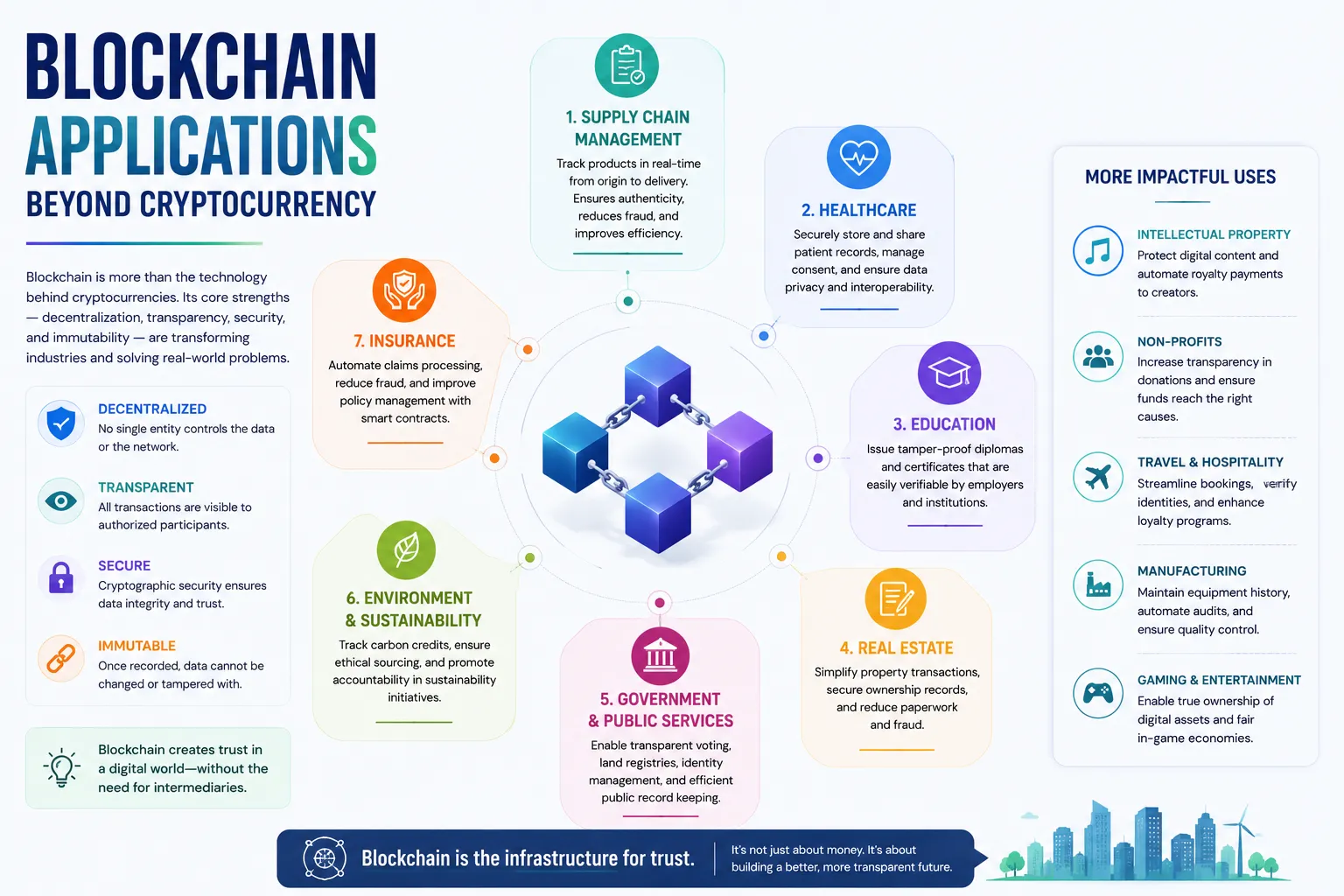
Blockchain Applications Beyond Cryptocurrency
When blockchain technology first gained global attention, it was primarily associated with cryptocurrency and digital assets. While cryptocurrencies remain an important use case, blockchain has evolved far beyond digital currencies. Today, organizations across finance, healthcare, supply chain management, cybersecurity, government services, real estate, insurance, and enterprise technology are exploring blockchain solutions to improve transparency, security, efficiency, and trust.
Blockchain is fundamentally a distributed ledger technology that enables secure, immutable, and transparent record-keeping across decentralized networks. Its ability to create tamper-resistant records and automate processes through smart contracts makes it one of the most transformative technologies of the digital era.
As businesses continue investing in digital transformation initiatives, blockchain is emerging as a powerful infrastructure layer capable of reducing operational costs, streamlining workflows, enhancing security, and improving compliance. This evolution has opened significant opportunities for enterprises seeking innovative solutions to modern business challenges.
This comprehensive guide explores how blockchain technology is being applied beyond cryptocurrency and why it is becoming a critical component of future digital ecosystems.
Understanding Blockchain Technology
Blockchain is a distributed database that records transactions across multiple computers. Once information is recorded, it becomes extremely difficult to alter, providing a high level of integrity and trust.
Key characteristics include:
- Decentralization
- Transparency
- Immutability
- Security
- Traceability
- Automation capabilities
These features make blockchain suitable for a wide range of enterprise applications beyond cryptocurrency trading and digital assets.
| Blockchain Feature | Business Benefit |
|---|---|
| Distributed Ledger | Improved Transparency |
| Immutable Records | Enhanced Security |
| Smart Contracts | Process Automation |
| Decentralization | Reduced Single Points of Failure |
| Cryptographic Security | Data Protection |
Supply Chain Management and Traceability
One of the most successful blockchain applications outside cryptocurrency is supply chain management.
Global supply chains often involve multiple stakeholders, including manufacturers, suppliers, distributors, logistics providers, and retailers. Tracking products across these networks can be complex and inefficient.
Blockchain helps organizations:
- Track products in real time
- Verify product authenticity
- Reduce fraud
- Improve inventory visibility
- Enhance compliance reporting
By creating a permanent record of product movement, blockchain improves transparency throughout the supply chain lifecycle.
Smart Contracts and Business Automation
Smart contracts are self-executing agreements stored on blockchain networks.
These contracts automatically execute predefined actions when specific conditions are met.
Applications include:
- Payment processing
- Insurance claims
- Vendor agreements
- Procurement workflows
- Service-level compliance
Smart contracts reduce administrative costs while minimizing human error and delays.
Digital Identity Management
Identity verification remains a major challenge in today's digital economy.
Blockchain-based identity systems offer secure and decentralized alternatives to traditional identity management solutions.
Benefits include:
- Enhanced privacy
- Reduced identity theft
- Improved authentication
- User-controlled credentials
- Cross-platform verification
Financial institutions, governments, and enterprises are increasingly exploring blockchain identity solutions.
Healthcare Data Management
The healthcare industry generates massive amounts of sensitive patient data that must be protected while remaining accessible to authorized providers.
Blockchain can improve:
- Medical record security
- Data sharing
- Patient consent management
- Healthcare interoperability
- Audit transparency
Secure healthcare data exchange has become one of the most promising enterprise blockchain use cases.
| Healthcare Challenge | Blockchain Solution |
|---|---|
| Data Fragmentation | Unified Records |
| Unauthorized Access | Enhanced Security |
| Audit Complexity | Immutable Logs |
| Patient Consent | Smart Contract Controls |
Blockchain in Financial Services
While cryptocurrency is only one aspect of blockchain in finance, financial institutions are utilizing blockchain for numerous operational improvements.
Applications include:
- Cross-border payments
- Trade finance
- Asset tokenization
- Settlement systems
- Compliance reporting
- Fraud prevention
Blockchain infrastructure can help reduce transaction costs while increasing speed and transparency.
Trade Finance Modernization
International trade often involves multiple intermediaries, extensive documentation, and lengthy settlement processes.
Blockchain-based trade finance solutions can:
- Digitize documentation
- Reduce paperwork
- Accelerate settlements
- Improve transaction visibility
- Lower operational costs
These benefits make blockchain highly attractive for global commerce and enterprise banking operations.
Real Estate Transactions
The real estate sector is increasingly exploring blockchain-based solutions.
Potential applications include:
- Property ownership records
- Title management
- Smart contract transactions
- Asset tokenization
- Property investment platforms
Blockchain can reduce paperwork while improving transparency and transaction efficiency.
Cybersecurity and Data Protection
Cybersecurity remains a top concern for organizations worldwide.
Blockchain enhances security through:
- Distributed data storage
- Cryptographic verification
- Immutable audit trails
- Tamper-resistant records
- Decentralized architectures
Organizations increasingly leverage blockchain to strengthen data integrity and reduce cyber risks.
Insurance Industry Applications
Insurance companies are adopting blockchain to improve efficiency and customer experiences.
Use cases include:
- Claims automation
- Policy management
- Fraud detection
- Risk assessment
- Customer verification
Smart contracts can automate claim processing while reducing administrative overhead.
| Insurance Process | Blockchain Benefit |
|---|---|
| Claims Processing | Automation |
| Policy Verification | Transparency |
| Fraud Prevention | Immutable Records |
| Customer Onboarding | Identity Verification |
Government and Public Sector Applications
Governments worldwide are evaluating blockchain technology for public sector modernization.
Potential applications include:
- Digital identity programs
- Voting systems
- Public records management
- Licensing systems
- Tax administration
Blockchain can improve transparency, accountability, and operational efficiency across government services.
Enterprise Document Management
Businesses manage enormous volumes of contracts, certifications, reports, and regulatory documentation.
Blockchain-based document management systems provide:
- Document authenticity verification
- Audit trails
- Version control
- Access management
- Compliance support
These capabilities are particularly valuable in highly regulated industries.
Blockchain and Cloud Computing Integration
Many organizations are integrating blockchain with cloud infrastructure to achieve greater scalability and accessibility.
Benefits include:
- Lower deployment costs
- Improved flexibility
- Enhanced scalability
- Global accessibility
- Enterprise-grade performance
Blockchain-as-a-Service platforms continue simplifying enterprise adoption.
Asset Tokenization
Asset tokenization is one of the fastest-growing blockchain applications.
Tokenization enables physical or financial assets to be represented digitally on blockchain networks.
Examples include:
- Real estate
- Private equity
- Investment funds
- Intellectual property
- Luxury assets
Tokenization can improve liquidity, accessibility, and investment efficiency.
Decentralized Data Management
Traditional centralized databases can create security and operational risks.
Blockchain-based data management systems offer:
- Enhanced resilience
- Improved integrity
- Reduced downtime risks
- Better transparency
- Secure information sharing
This makes blockchain increasingly attractive for enterprise-grade applications.
Challenges to Enterprise Blockchain Adoption
Despite its advantages, blockchain adoption still faces several challenges.
- Scalability concerns
- Integration complexity
- Regulatory uncertainty
- Implementation costs
- Talent shortages
- Governance requirements
Organizations must carefully evaluate both opportunities and limitations before implementing blockchain initiatives.
Future Trends in Blockchain Technology
The future of blockchain extends far beyond digital currencies.
Emerging trends include:
- Enterprise blockchain networks
- AI and blockchain integration
- Digital identity ecosystems
- Automated compliance platforms
- Advanced smart contract frameworks
- Cross-industry interoperability
- Blockchain-powered cybersecurity systems
These innovations are expected to accelerate adoption across multiple industries.
Business Benefits of Blockchain Adoption
Organizations investing in blockchain technology can potentially achieve significant business advantages.
- Improved transparency
- Lower operational costs
- Enhanced security
- Faster transaction processing
- Better compliance management
- Increased automation
- Greater trust among stakeholders
These benefits explain why blockchain remains a strategic priority for many enterprise digital transformation initiatives.
Conclusion
Blockchain technology has evolved far beyond its origins in cryptocurrency. Today, it serves as a powerful foundation for innovation across supply chain management, healthcare, finance, cybersecurity, insurance, real estate, government services, and enterprise operations.
By providing secure, transparent, and decentralized systems for managing data and transactions, blockchain enables organizations to improve efficiency, reduce costs, strengthen trust, and automate complex workflows. As enterprise adoption continues growing, blockchain is expected to become a critical component of next-generation digital infrastructure.
The organizations that successfully integrate blockchain into their long-term technology strategies will be better positioned to capitalize on future opportunities in an increasingly connected and data-driven global economy.